Interfacial phenomena and microscale flow in energy extraction and underground energy storage: Recent advances and future perspectives
Abstract
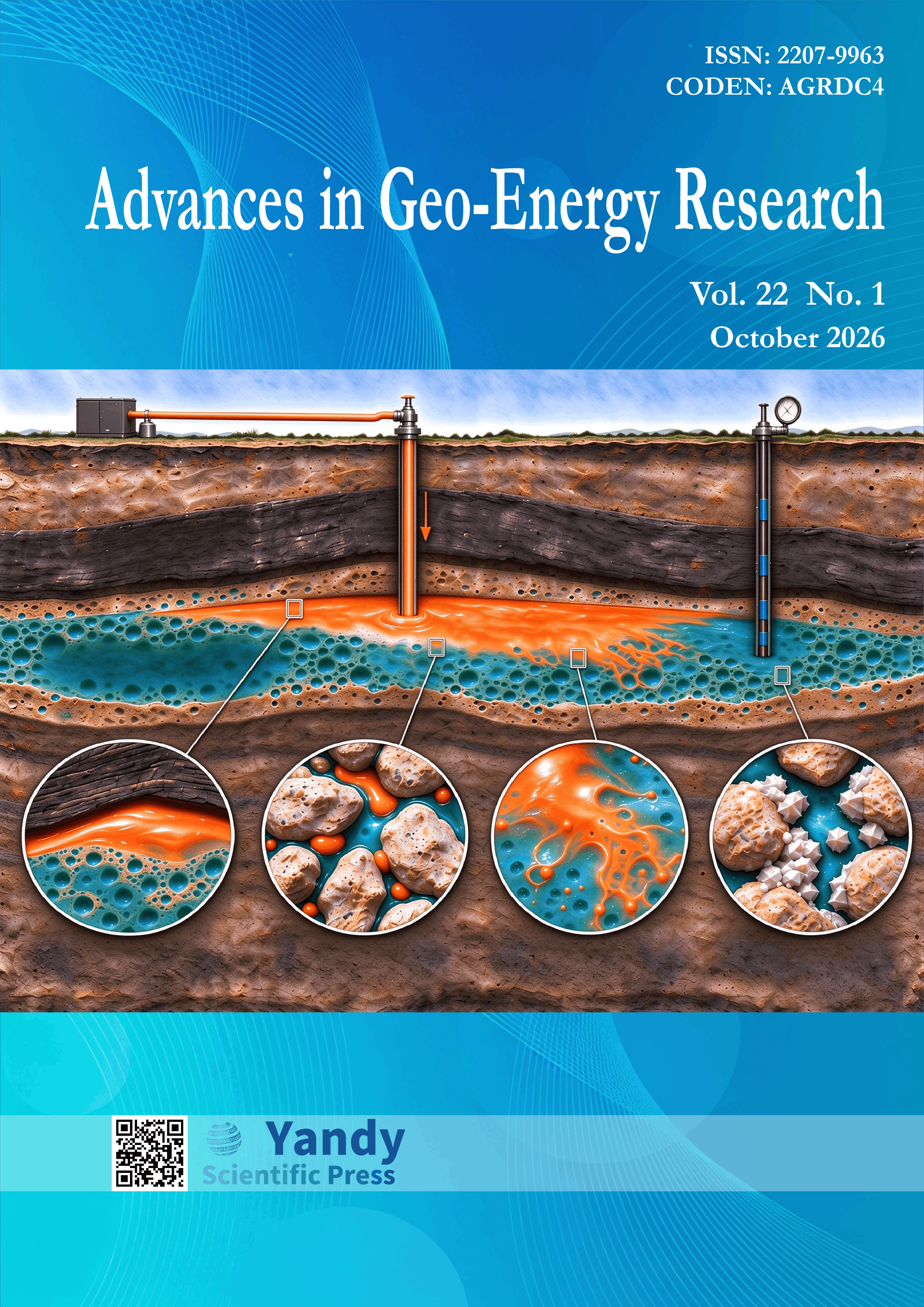
Interfacial interactions and nanoconfined fluid transport are key factors influencing the efficiency and safety of unconventional oil and gas recovery, geological CO₂ storage, and underground hydrogen storage. This paper examines competitive CO₂ adsorption, interfacial water structure, and the mechanisms regulating confined flow, with the aim of identifying microscopic processes common across these different geo-energy contexts. Existing research shows that CO₂-pore wall interactions are strongly scenario-dependent: they can enhance competitive displacement in shale gas recovery, yet in underground hydrogen storage they may instead occupy usable pore space and increase transport resistance. The hydrogen-bond network of interfacial water, together with the water films and water bridges it forms, further governs CO₂ adsorption, dissolution, and migration. These structures can also contribute to an “imbibition water shield”, which can impede contact and mass transfer between CO₂ and crude oil. Ions, external physical fields and chemical additives can regulate confined flow by altering aqueous-phase structure, interfacial tension, pore connectivity and wettability. Together, these findings provide a theoretical basis for improving hydrocarbon recovery efficiency, subsurface storage capacity, and long-term operational safety.
Document Type: Perspective
Cited as: Zhan, S., Wu, J., Zhang, M., Pan, B., Du, J., Guo, S. Interfacial phenomena and microscale flow in energy extraction and underground energy storage: Recent advances and future perspectives. Advances in Geo-Energy Research, 2026, 22(1): 95–100. https://doi.org/10.46690/ager.2026.10.09
DOI:
https://doi.org/10.46690/ager.2026.10.09Keywords:
Nanoconfinement effects, unconventional energy, enhanced recovery, underground hydrogen storageReferences
Agi, A., Junin, R., Jaafar, M. Z., et al. Laboratory evaluation to field application of ultrasound: A state-of-the-art review on the effect of ultrasonication on enhanced oil recovery mechanisms. Journal of Industrial and Engineering Chemistry, 2022, 110: 100-119.
Bao, J., Du, J., Zhan, S., et al. A molecular perspective on the microscopic mechanisms of CO₂ injection and water films in fluid transport and enhanced oil recovery. Advances in Geo-Energy Research, 2025, 16(3): 288-292.
Du, J., Zhou, A., Zhong, Y., et al. Molecular simulation on CO₂ adsorption heterogeneity in montmorillonite nanopores with different surface charges in presence of water. Chemical Engineering Journal, 2024, 482: 148958.
He, Y., Liu, M., Tang, Y., et al. CO₂ storage capacity estimation by considering CO₂ dissolution: A case study in a depleted gas reservoir, China. Journal of Hydrology, 2024, 630: 130715.
Heinemann, N., Alcalde, J., Miocic, J. M., et al. Enabling large-scale hydrogen storage in porous media-the scientific challenges. Energy & Environmental Science, 2021, 14(2): 853-864.
Hong, X., Jin, X., Shen, M., et al. Enhancement of oil transport through nanopores via cation exchange in thin brine films at rock-oil interface. Advances in Geo-Energy Research, 2024, 12(1): 22-34.
Iglauer, S. CO₂-water-rock wettability: Variability, influencing factors, and implications for CO₂ geostorage. Accounts of Chemical Research, 2017, 50(5): 1134-142.
Krevor, S., De Coninck, H., Gasda, S. E., et al. Subsurface carbon dioxide and hydrogen storage for a sustainable energy future. Nature Reviews Earth & Environment, 2023, 4(2): 102-118.
Li, W., Nan, Y., Zhang, Z., et al. Hydrophilicity/hydrophobicity driven CO₂ solubility in kaolinite nanopores in relation to carbon sequestration. Chemical Engineering Journal, 2020, 398: 125449.
Liu, K., Zhu, W., Pan, B. Feasibility of hydrogen storage in depleted shale gas reservoir: A numerical investigation. Fuel, 2024, 357: 129703.
Pan, B., Matamba, T., Yin, X., et al. Experimental investigations of the impact of H₂, He, CH₄, and CO₂ exposure on kerogen adsorption, wettability, and geomechanical characteristics at geo-storage conditions. SPE Journal, 2025, 30(6): 3829-3838.
Selley, R. C. Elements of petroleum geology. Gulf Professional Publishing, 1998.
Wang, J., Ding, H., Cao, B. C., et al. Effect of ionic liquid confinement on CO₂ solubility and permeability characteristics. Greenhouse Gases: Science and Technology, 2017, 7(3): 474-485.
Wang, J., Yang, Y., Cai, S., et al. Pore-scale modelling on hydrogen transport in porous media: Implications for hydrogen storage in saline aquifers. International Journal of Hydrogen Energy, 2023, 48(37): 13922-13933.
Xie, M., Zhang, M., Duan, L., et al. Interfacial water structure effect on CO₂ solubility in water-saturated silica confinements: A molecular perspective. Journal of Colloid and Interface Science, 2025: 139702.
Yang, Y., Yin, X., Yang, Y., et al. Numerical simulations of depleted (CH₄) and cushion (CO₂) gases impacts on H₂ withdrawal and CO₂ storage efficiencies in a depleted gas reservoir. Fuel, 2025, 380: 133095.
Zhan, S., Bao, J., Wang, X., et al. A comparative study of shale oil transport behavior in graphene and kerogen nanopores with various roughness via molecular dynamics simulations. Chemical Engineering Journal, 2024, 498: 155173.
Zhang, M., Yang, Y., Pan, B., et al. Molecular simulation on H₂ adsorption in nanopores and effects of cushion gas: Implications for underground hydrogen storage in shale reservoirs. Fuel, 2024, 361: 130621.
Downloads
Downloads
Published
How to Cite
Issue
Section
License
Copyright (c) 2026 Shiyuan Zhan, Jing Wu, Mingshan Zhang, Bin Pan, Jiapei Du, Shuaijiang Guo

This work is licensed under a Creative Commons Attribution-NonCommercial-NoDerivatives 4.0 International License.