Thermo-hydro-chemical coupled numerical modeling of hydrogen-thermal co-development in hydraulically fractured peridotite
Abstract
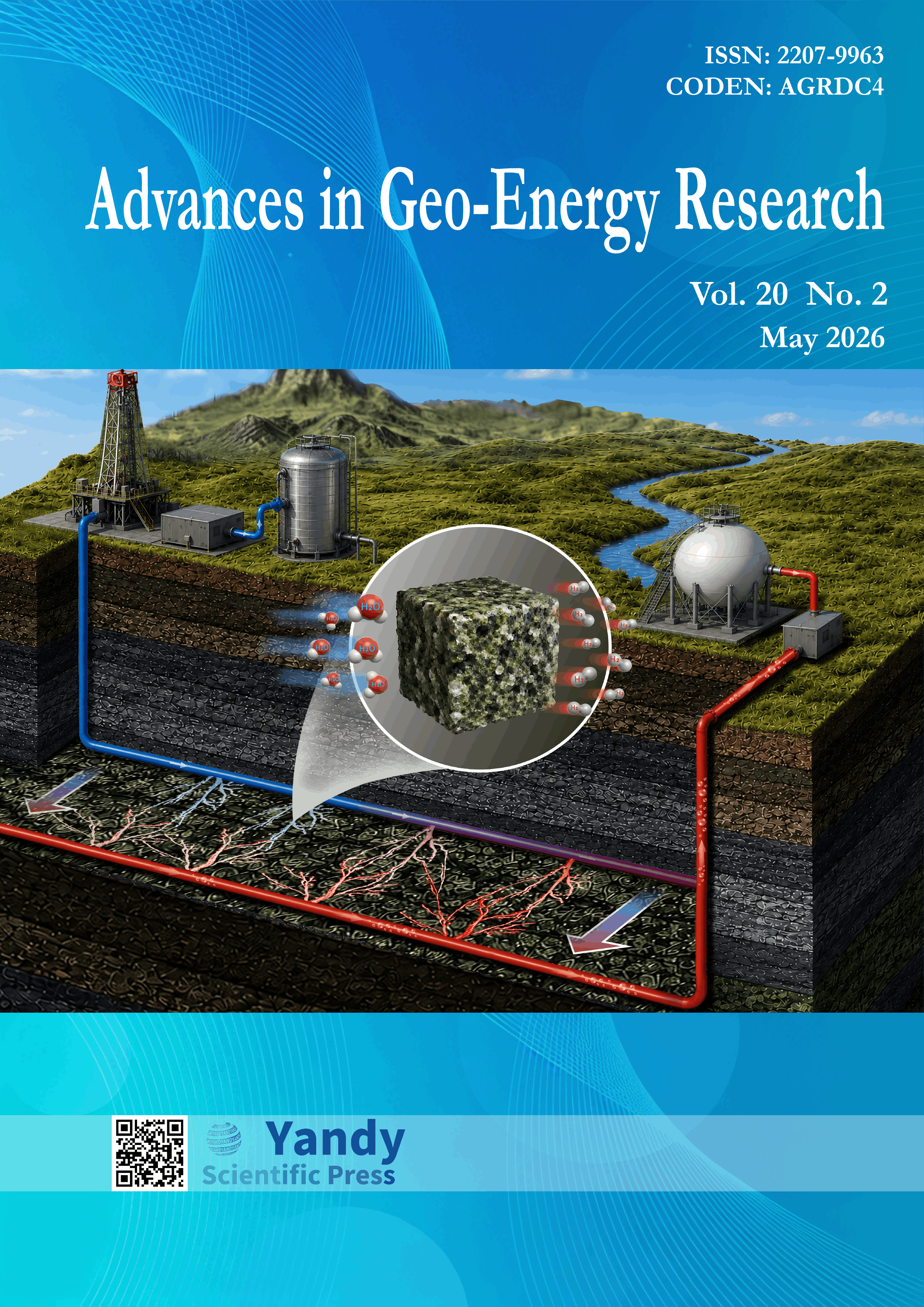
Hydrogen generation through serpentinization reactions in peridotite formations under high temperature conditions represents a promising avenue for subsurface hydrogen production. However, the thermal energy in the formation environment have not been sufficiently considered. To integrate hydrogen production with thermal energy development, this study develops a thermo-hydro-chemical coupled numerical model, which is used to investigate hydrogen-thermal co-development in hydraulically fractured peridotite. Given that the hydrogen-thermal co-development process involves fluid flow, heat transfer and serpentinization reactions, the governing equations are formulated based on Darcy flow and energy conservation equations, with serpentinization kinetics incorporated through the reactive source terms. To evaluate hydrogen production and thermal energy recovery under varying formation and injection fluid temperatures, the coupled system is solved numerically. The results show that under high geothermal temperature conditions, continuous high-temperature injection combined with moderate natural fracture development can sustain stable high production during long-term operation. When the contribution of thermal energy is neglected, the total system energy output decreases significantly, highlighting the necessity of hydrogen-thermal co-development. This study further identifies the optimal injection temperature range under high geothermal conditions. Under normal geothermal conditions, hydrogen production is limited by reaction temperature, and high-level production cannot be maintained solely through thermal stimulation. Sensitivity analysis reveals that reaction kinetics are the dominant factor controlling system hydrogen productivity, and enhancing them can increase hydrogen production by nearly an order of magnitude. This work establishes a quantitative framework for artificial hydrogen generation and provides theoretical guidance for engineering design and the operational parameter optimization of hydrogen-thermal co-development systems.
Document Type: Original article
Cited as: Dai, J., Ma, Z., Yue, Y., Yuan, Y., Tian, S. Thermo-hydro-chemical coupled numerical modeling of hydrogen-thermal co-development in hydraulically fractured peridotite. Advances in Geo-Energy Research, 2026, 20(2): 145-162. https://doi.org/10.46690/ager.2026.05.04
DOI:
https://doi.org/10.46690/ager.2026.05.04Keywords:
Thermo-hydro-chemical coupled, numerical model, hydrogen-thermal co-development, serpentinization, sensitivity analysisReferences
Abidoye, L. K., Khudaida, K. J., Das, D. B. Geological carbon sequestration in the context of two-phase flow in porous media: A review. Critical Reviews in Environmental Science and Technology, 2015, 45(11): 1105-1147.
Albers, E., Bach, W., Pérez-Gussinyé, M., et al. Serpentinization-driven H₂ production from continental break-up to mid-ocean ridge spreading: Unexpected high rates at the West Iberia margin. Frontiers in Earth Science, 2021, 9: 673063.
Aliyu, M. D., Archer, R. A. A thermo-hydro-mechanical model of a hot dry rock geothermal reservoir. Renewable Energy, 2021, 176: 47-493.
Allen, D. E., Seyfried, W. E. Serpentinization and heat generation: Constraints from Lost City and Rainbow hydrothermal systems. Geochimica et Cosmochimica Acta, 2004, 68(6): 1347-1354.
Aquino, K. A., Perez, A. dC., Juego, C. M. M., et al. High hydrogen outgassing from an ophiolite-hosted seep in Zambales, Philippines. International Journal of Hydrogen Energy, 2025, 105: 360-366.
Arekhov, V., Zhainakov, T., Clemens, T., et al. Influence of water saturation, temperature and pressure on the effective hydrogen-methane gas diffusion in reservoir rocks. Paper SPE 220008 Presented at SPE Europe Energy Conference and Exhibition, Turin, Italy, 26-28 June, 2024.
Boon, M., Rademaker, T., Winardhi, C. W., et al. Multiscale experimental study of H₂/brine multiphase flow in porous rock characterizing relative permeability hysteresis, hydrogen dissolution, and Ostwald ripening. Scientific Reports, 2024, 14(1): 30170.
Brandt, A. R. Greenhouse gas intensity of natural hydrogen produced from subsurface geologic accumulations. Joule, 2023, 7(8): 1818-1831.
Cao, J., Zhang, N., James, L. A., et al. Modeling semi-steady state near-well flow performance for horizontal wells in anisotropic reservoirs. Computational Geosciences, 2018, 22(3): 725-744.
Davies, R. J., Mathias, S. A., Moss, J., et al. Hydraulic fractures: How far can they go? Marine and Petroleum Geology, 2012, 37(1): 1-6.
Egert, R., Neupane, G., Jin, W. On the viability of stimulated hydrogen generation from iron-rich formations. Geoenergy Science and Engineering, 2026, 256: 214130.
Emmanuel, S., Berkowitz, B. Suppression and stimulation of seafloor hydrothermal convection by exothermic mineral hydration. Earth and Planetary Science Letters, 2006, 243(3-4): 657-668.
Flude, S., Warr, O., Magalhães, N., et al. Generation, migration and accumulation of natural hydrogen and helium in the intracratonic São Francisco Basin, eastern Brazil: Implications for the understanding and exploration of natural H₂ systems. Geoenergy, 2025, 3(1): geoenergy2024042.
Foustoukos, D. I., Seyfried, W. E. Hydrocarbons in hydrothermal vent fluids: The role of chromium-bearing catalysts. Science, 2004, 304(5673): 1002-1005.
Frost, B. R., Beard, J. S. On silica activity and serpentinization. Journal of Petrology, 2007, 48(7): 1351-1368.
Gabriel, K. S., El-Emam, R. S., Zamfirescu, C. Technoeconomics of large-scale clean hydrogen production - A review. International Journal of Hydrogen Energy, 2022, 47(72): 30788-30798.
Hatakeyama, K., Katayama, I., Hirauchi, K., et al. Mantle hydration along outer-rise faults inferred from serpentinite permeability. Scientific Reports, 2017, 7(1): 13870.
Hsieh, J. C., Li, B. H., Lee, B. H., et al. Performance and economic analyses of a geothermal reservoir model coupled with a flash-binary cycle model. Renewable Energy, 2024, 230: 120826.
Huang, R., Song, M., Ding, X., et al. Influence of pyroxene and spinel on the kinetics of peridotite serpentinization. Journal of Geophysical Research: Solid Earth, 2017, 122(9): 7111-7126.
Ingersoll, L. R., Zobel, O. J., Ingersoll, A. C. Heat conduction with engineering, geological, and other applications. Physics Today, 1955, 8(3): 17.
Jackson, O., Lawrence, S. R., Hutchinson, I. P., et al. Natural hydrogen: Sources, systems and exploration plays. Geoenergy, 2024, 2(1): geoenergy2024-002.
Kelley, D. S., Karson, J. A., Früh-Green, G. L., et al. A serpentinite-hosted ecosystem: The Lost City hydrothermal field. Science, 2005, 307(5714): 1428-1434.
Kottwitz, M. O., Popov, A. A., Baumann, T. S., et al. The hydraulic efficiency of single fractures: Correcting the cubic law parameterization for self-affine surface roughness and fracture closure. Solid Earth, 2020, 11(3): 947-957.
Li, T., Shiozawa, S., McClure, M. W. Thermal breakthrough calculations to optimize design of a multiple-stage enhanced geothermal system. Geothermics, 2016, 64: 455-465.
Liu, J., Wang, S., Javadpour, F., et al. Hydrogen diffusion in clay slit: Implications for the geological storage. Energy & Fuels, 2022, 36(14): 7651-7660.
Liu, J., Wolterbeek, T. K. T., Spiers, C. J. Volumetric response and permeability evolution during carbonation of crushed peridotite under controlled stress-pressure-temperature conditions. International Journal of Rock Mechanics and Mining Sciences, 2024, 182: 105886.
Lollar, B. S., Onstott, T. C., Lacrampe-Couloume, G., et al. The contribution of the Precambrian continental lithosphere to global H₂ production. Nature, 2014, 516(7531): 379-382.
Luhmann, A. J., Tutolo, B. M., Bagley, B. C., et al. Chemical and physical changes during seawater flow through intact dunite cores: An experimental study at 150-200 °C. Geochimica et Cosmochimica Acta, 2017, 214: 86-114.
Mahmoodpour, S., Singh, M., Turan, A., et al. Simulations and global sensitivity analysis of the thermo-hydraulic-mechanical processes in a fractured geothermal reservoir. Energy, 2022, 247: 123511.
Malvoisin, B., Brunet, F. Water diffusion-transport in a synthetic dunite: Consequences for oceanic peridotite serpentinization. Earth and Planetary Science Letters, 2014, 403: 263-272.
Malvoisin, B., Brunet, F., Carlut, J., et al. Serpentinization of oceanic peridotites: 2. Kinetics and processes of San Carlos olivine hydrothermal alteration. Journal of Geophysical Research: Solid Earth, 2012, 117(B4): 2011JB008842.
Malvoisin, B., Dörfler, P., Auzende, A.-L., et al. Magnetite production in mesh texture during serpentinization, a marker of H₂ diffusion. Journal of Petrology, 2026, 67(4): egag021.
Manfredi, A., Manfrida, G., Carcasci, C., et al. Integration of hydrogen production with geothermal power plants: Utilizing H₂ as a spinning reserve unit. Renewable Energy, 2026, 256: 124630.
Mao, S., Yu, S., Xu, J., et al. Geologic hydrogen: A review of resource potential, subsurface dynamics, exploration, production, transportation, and research opportunities. Energy & Environmental Science, 2025, 18(23): 9991-10035.
Marcaillou, C., Muñoz, M., Vidal, O., et al. Mineralogical evidence for H₂ degassing during serpentinization at 300 °C/300 bar. Earth and Planetary Science Letters, 2011, 303(3-4): 281-290.
Martin, B., Fyfe, W. S. Some experimental and theoretical observations on the kinetics of hydration reactions with particular reference to serpentinization. Chemical Geology, 1970, 6: 185-202.
McCollom, T. M., Bach, W. Thermodynamic constraints on hydrogen generation during serpentinization of ultramafic rocks. Geochimica et Cosmochimica Acta, 2009, 73(3): 856-875.
McCollom, T. M., Klein, F., Robbins, M., et al. Temperature trends for reaction rates, hydrogen generation, and partitioning of iron during experimental serpentinization of olivine. Geochimica et Cosmochimica Acta, 2016, 181: 175-200.
McCollom, T. M., Klein, F., Solheid, P., et al. The effect of pH on rates of reaction and hydrogen generation during serpentinization. Philosophical Transactions of the Royal Society A: Mathematical, Physical and Engineering Sciences, 2020, 378(2165): 20180428.
Moretti, I., Baby, P., Alvarez Zapata, P., et al. Subduction and hydrogen release: The case of Bolivian Altiplano. Geosciences, 2023, 13(4): 109.
Mügler, C., Jean-Baptiste, P., Perez, F., et al. Modeling of hydrogen production by serpentinization in ultramafic-hosted hydrothermal systems: Application to the Rainbow field. Geofluids, 2016, 16(3): 476-489.
Nadaleti, W. C., Lourenço, V. A., Americo, G. Green hydrogen-based pathways and alternatives: Towards the renewable energy transition in South America’s regions - Part A. International Journal of Hydrogen Energy, 2021, 46(43): 22247-22255.
Norbeck, J. H., McClure, M. W., Horne, R. N. Field observations at the Fenton Hill enhanced geothermal system test site support mixed-mechanism stimulation. Geothermics, 2018, 74: 135-149.
Noyan, O. F., Hasan, M. M., Pala, N. A global review of the hydrogen energy eco-system. Energies, 2023, 16(3): 1484.
Okere, C. J., Sheng, J. J. Optimizing hydrogen generation from petroleum reservoirs: A dual-perspective approach for enhancing efficiency and cleaner production. Gas Science and Engineering, 2025, 136: 205576.
Okland, I., Huang, S., Thorseth, I. H., et al. Formation of H₂, CH₄ and N-species during low-temperature experimental alteration of ultramafic rocks. Chemical Geology, 2014, 387: 22-34.
Osselin, F., Soulaine, C., Fauguerolles, C., et al. Orange hydrogen is the new green. Nature Geoscience, 2022, 15(10): 765-769.
Perez, F., Mügler, C., Jean-Baptiste, P., et al. Coupled modeling of thermics and hydrogeology with the Cast3M code: Application to the Rainbow hydrothermal field (Mid-Atlantic Ridge, 36°14’N). Computational Geosciences, 2013, 17(2): 217-237.
Prinzhofer, A., Moretti, I., Françolin, J., et al. Natural hydrogen continuous emission from sedimentary basins: The example of a Brazilian H₂-emitting structure. International Journal of Hydrogen Energy, 2019, 44(12): 5676-5685.
Prinzhofer, A., Tahara Cissé, C. S., Diallo, A. B. Discovery of a large accumulation of natural hydrogen in Bourakebougou (Mali). International Journal of Hydrogen Energy, 2018, 43(42): 19315-19326.
Rezaee, R. Quantifying natural hydrogen generation rates and volumetric potential in onshore serpentinization. Geosciences, 2025, 15(3): 112.
Roumejon, S., Cannat, M., Agrinier, P., et al. Serpentinization and fluid pathways in tectonically exhumed peridotites from the Southwest Indian Ridge (62-65°E). Journal of Petrology, 2015, 56(4): 703-734.
Shimizu, H., Okamoto, A. The roles of fluid transport and surface reaction in reaction-induced fracturing, with implications for the development of mesh textures in serpentinites. Contributions to Mineralogy and Petrology, 2016, 171(8-9): 73.
Strauch, B., Pilz, P., Hierold, J., et al. Experimental simulations of hydrogen migration through potential storage rocks. International Journal of Hydrogen Energy, 2023, 48(66): 25808-25820.
Vallejo, V., Nguyen, Q., Ravikumar, A. P. Geospatial variation in carbon accounting of hydrogen production and implications for the US Inflation Reduction Act. Nature Energy, 2024, 9(12): 1571-1571.
Wang, T., Yang, Y., Peng, Y., et al. Simulation and evaluation for acid fracturing of carbonate reservoirs based on embedded discrete fracture model. Natural Gas Industry B, 2021, 8(6): 637-649.
Wang, X., Yu, Z., Sun, P., et al. Serpentinization-mediated H₂ generation and its genesis link to supra-subduction zone ophiolites. Earth-Science Reviews, 2026, 273: 105369.
Wang, Y., Zhou, F., Zhang, Y., et al. Numerical studies and analysis on reaction characteristics of limestone and dolomite in carbonate matrix acidizing. Geoenergy Science and Engineering, 2023, 222: 211452.
Wu, H., Zhang, J., Fu, P., et al. Inferring fracture aperture distribution at the EGS Collab Experiment 1 Testbed through a deep learning accelerated Bayesian approach. Paper SGP-TR-218 Presented at 46th Workshop on Geothermal Reservoir Engineering, Stanford University, Stanford, California, 15-17 February, 2021.
Zgonnik, V. The occurrence and geoscience of natural hydrogen: A comprehensive review. Earth-Science Reviews, 2020, 203: 103140.
Zgonnik, V., Beaumont, V., Larin, N., et al. Diffused flow of molecular hydrogen through the Western Hajar mountains, Northern Oman. Arabian Journal of Geosciences, 2019, 12(3): 71.
Zhang, Z., Jia, G., Ma, Z., et al. Parameter optimization and ground temperature analysis of a solar-assisted medium-deep geothermal heating system under long-term operation. Renewable Energy, 2026, 261: 125234.
Zhao, K., Li, R., Lei, H., et al. Numerical simulation of influencing factors of hydraulic fracture network development in reservoirs with pre-existing fractures. Processes, 2022, 10(4): 773.
Downloads
Downloads
Published
How to Cite
Issue
Section
License
Copyright (c) 2026 Author(s)

This work is licensed under a Creative Commons Attribution-NonCommercial-NoDerivatives 4.0 International License.