Multiscale energy and mass transport for a sustainable geo-energy future
Abstract
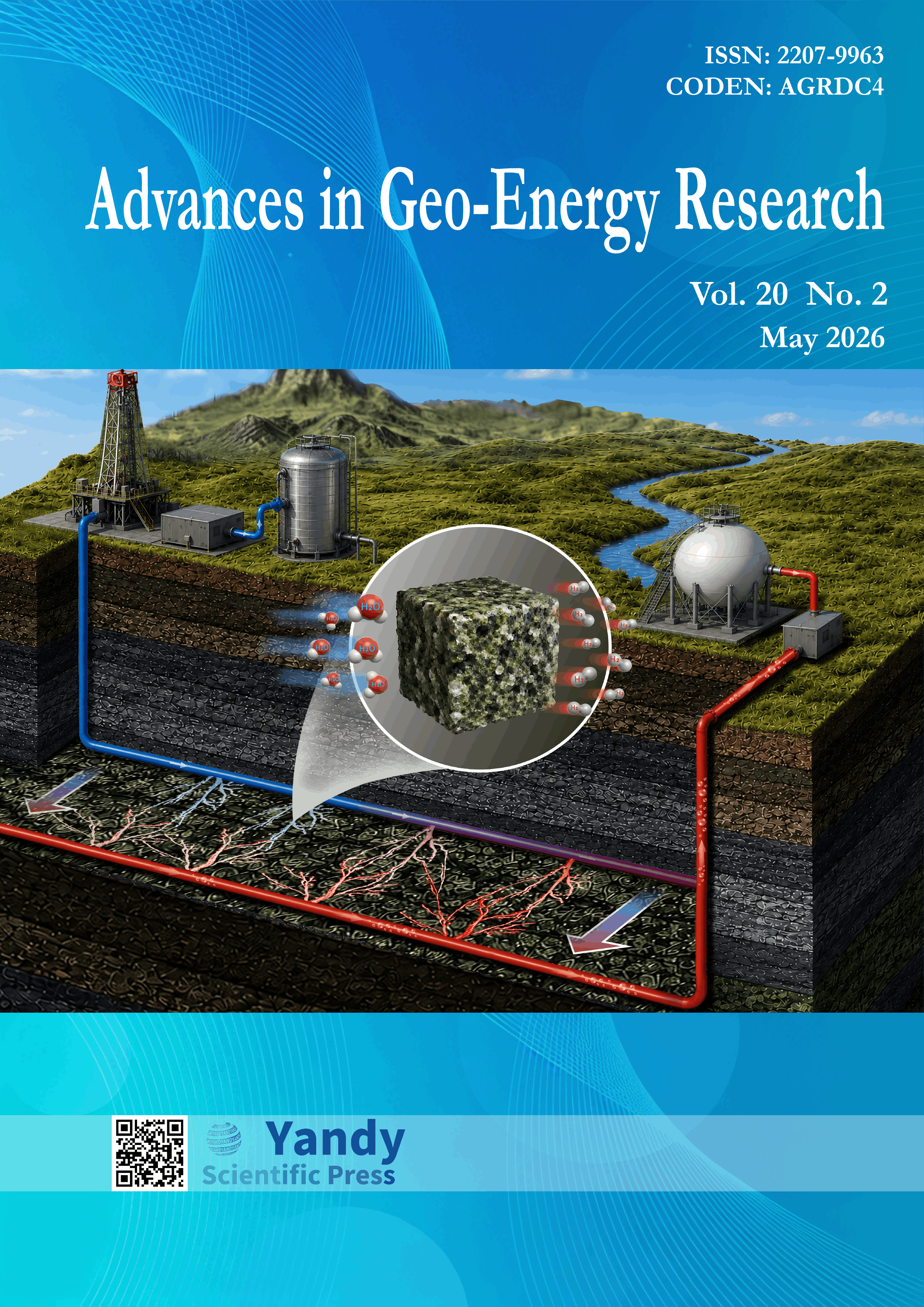
Multiscale energy and mass transport processes constitute the fundamental scientific foundation for sustainable geo-energy development and carbon neutrality. This perspective synthesizes cutting-edge advances in the field into three transformative thematic areas: thermodynamically consistent pore-scale modeling with robust numerical schemes that embed fundamental physical laws into mathematical formulations; molecular-scale insights and data-driven acceleration techniques bridging nanoscopic interfacial phenomena to reservoir-scale engineering; and coupled multiphysics-artificial intelligence frameworks for hydrogen infrastructure safety and supercritical CO₂ geothermal systems. Recent research reveals a paradigm shift toward living digital twins that integrate rigorous mathematical physics, multiscale computing, and artificial intelligence, charting a clear course toward carbon-neutral energy systems.
Document Type: Perspective
Cited as: Zhang, T., He, S., Chen, H., Sun, S. Multiscale energy and mass transport for a sustainable geo-energy future. Advances in Geo-Energy Research, 2026, 20(2): 194-196. https://doi.org/10.46690/ager.2026.05.07
DOI:
https://doi.org/10.46690/ager.2026.05.07Keywords:
Multiscale transport, thermodynamic consistency, pore-scale modeling, geo-energy digital twinReferences
Chen, H., Dong, P., Sun, S., et al. A locally mass-conservative enriched Petrov-Galerkin method without penalty for the Darcy flow in porous media. Communications in Computational Physics, 2026, 39(4): 1199-1230.
Chen, H., Kou, J., Sun, S., et al. Fully mass-conservative IMPES schemes for incompressible two-phase flow in porous media. Computer Methods in Applied Mechanics and Engineering, 2019, 350: 641-663.
Creasy, N., Huang, L., Gasperikova, E., et al. CO2 rock physics modeling for reliable monitoring of geologic carbon storage. Communications Earth & Environment, 2024, 5(1): 333.
Kou, J., Wang, X., Du, S., et al. An energy stable linear numerical method for thermodynamically consistent modeling of two-phase incompressible flow in porous media. Journal of Computational Physics, 2022, 451: 110854.
Kovachki, N., Li, Z., Liu, B., et al. Neural operator: Learning maps between function spaces. Journal of Machine Learning Research, 2023, 24: 1-97.
Liu, J., Zhang, T., Sun, S. Review of deep learning algorithms in molecular simulations and perspective applications on petroleum engineering. Geoscience Frontiers, 2024, 15(2): 101735.
Raissi, M., Perdikaris, P., Karniadakis, G. E. Physics-informed neural networks: A deep learning framework for solving forward and inverse problems involving nonlinear partial differential equations. Journal of Computational Physics, 2019, 378: 686-707.
Sun, S., Firoozabadi, A., Wheeler, M. Introduction of COMPES: Finding directions in energy and computational science. Computational Energy Science, 2024, 1(1): 12.
Downloads
Downloads
Published
How to Cite
Issue
Section
License
Copyright (c) 2026 Tao Zhang, Shengpeng He, Huangxin Chen, Shuyu Sun

This work is licensed under a Creative Commons Attribution-NonCommercial-NoDerivatives 4.0 International License.