New seismic wave model for tight reservoirs: Incorporating non-Darcy flow and fractional viscoelasticity
Abstract
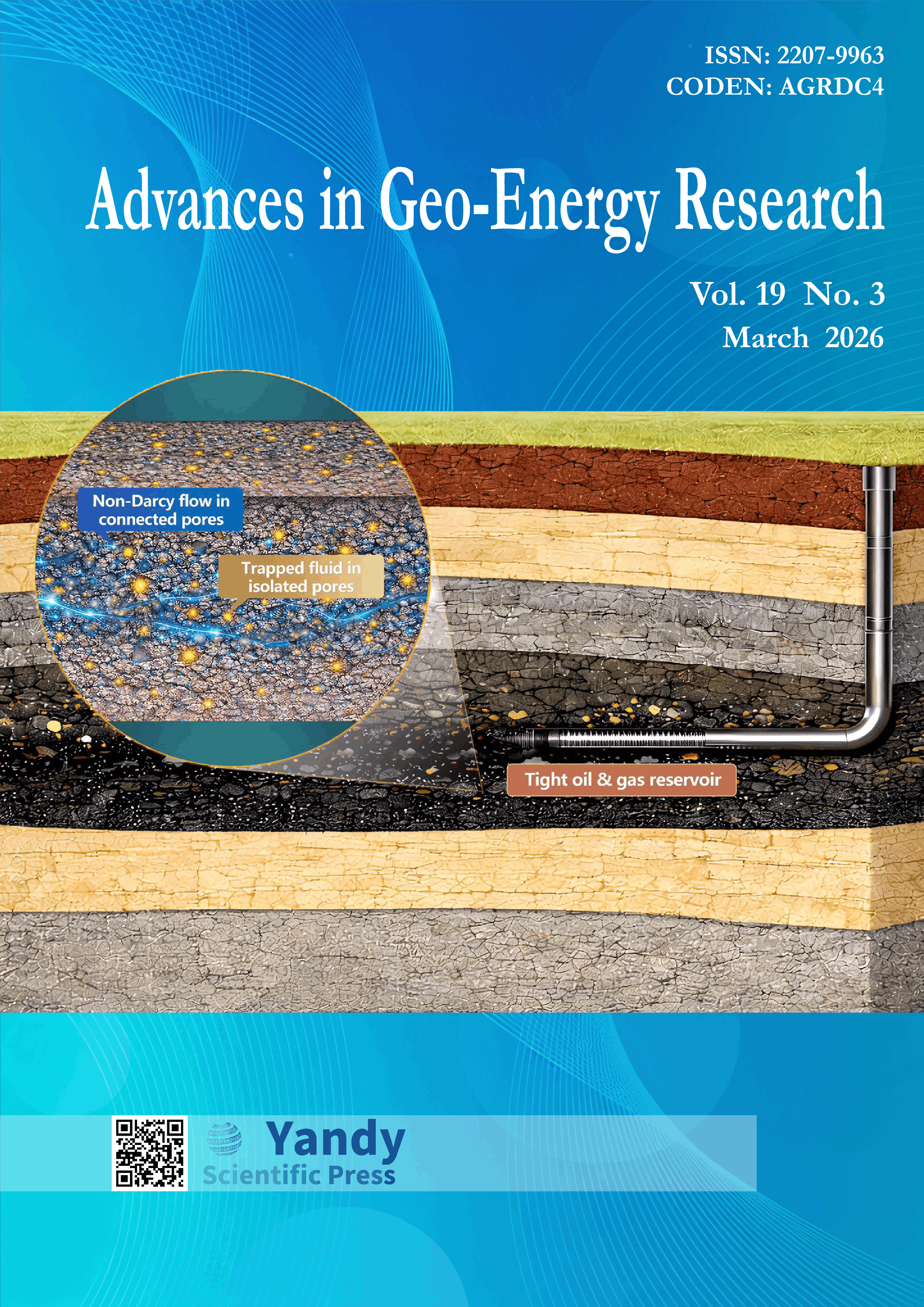
Seismic wave propagation in porous media is accompanied by frictional energy loss caused by the relative motion between the solid skeleton and pore fluids. In tight reservoirs, this process is more complex because extremely small pores and throats commonly induce nonlinear fluid flow. Meanwhile, most available wave propagation models are still based on Darcy’s law, therefore they are unable to fully capture the nonlinear flow behavior that occurs in the narrow pores and throats of tight reservoirs, as well as its influence on wave-induced dissipation. To characterize nonlinear seepage, a non-Darcy flow mechanism is incorporated into the model. Furthermore, tight reservoirs commonly contain a large umber of poorly connected or nearly isolated pores, in which fluids are trapped within the solid framework and cannot undergo significant seepage. Such trapped fluids are more appropriately regarded as part of an equivalent solid matrix that undergoes internal friction under wave excitation. This effect is further described by introducing a fractional viscoelastic mechanism. Based on these considerations, a new model is proposed to describe seismic wave propagation in tight reservoirs by integrating the effects of non-Darcy flow and fractional viscoelasticity. Plane-wave analysis and numerical examples demonstrate that the proposed model can describe dispersion and attenuation over a broad frequency range by incorporating multiple dissipation mechanisms. Comparisons with experimental data on tight cores confirm that the proposed model accurately predicts the phase velocities of seismic waves. Although this model provides a more accurate and physically consistent framework for seismic wave propagation in tight reservoirs, it is still limited to isotropic media and requires further development for anisotropic conditions such as fractured reservoirs..
Document Type: Original article
Cited as: Bu, F., Yang, D., Wen, J. New seismic wave model for tight reservoirs: Incorporating non-Darcy flow and fractional viscoelasticity. Advances in Geo-Energy Research, 2026, 19(3): 285-295. https://doi.org/10.46690/ager.2026.03.07
DOI:
https://doi.org/10.46690/ager.2026.03.07Keywords:
Tight reservoirs, non-Darcy flow, fractional derivative, poroviscoelasticity, dispersion, attenuationReferences
Ba, J., Zhu, H., Zhang, L., et al. Effect of multiscale cracks on seismic wave propagation in tight sandstones. Journal of Geophysical Research: Solid Earth, 2023, 128(10): e2023JB027474.
Ba, J., Carcione, J. M., Nie, J. Biot-Rayleigh theory of wave propagation in double-porosity media. Journal of Geo-physical Research: Solid Earth, 2011, 116(6): B06202.
Batzle, M. L., Han, D. H., Hofmann, R. Fluid mobility and frequency-dependent seismic velocity– Direct measurements. Geophysics, 2006, 71(1): N1-N9.
Biot, M. A. Theory of propagation of elastic waves in a f luid-saturated porous solid. I. Low-frequency range. The Journal of the Acoustical Society of America, 1956a, 28(2): 168-178.
Biot, M. A. Theory of propagation of elastic waves in a fluid-saturated porous solid. II. Higher frequency range. The Journal of the Acoustical Society of America, 1956b, 28(2): 179-191.
Biot, M. A. Generalized theory of acoustic propagation in porous dissipative media. The Journal of the Acoustical Society of America, 1962, 34: 1254-1264.
Bird, R. B., Stewart, W. E., Lightfoot, E. N. Transport Phenomena. New York, USA, John Wiley & Sons, 2002.
Cao, G., Lin, M., Zhang, L., et al. Numerical simulation of the dynamic migration mechanism and prediction of saturation of tight sandstone oil. Science China Earth Sciences, 2024, 67(1): 179-195.
Caputo, M. Vibrations of an infinite plate with a frequency independent Q. The Journal of the Acoustical Society of America, 1976, 60(3): 634-639.
Carcione, J. M. Wave Fields in Real Media: Wave Propagation in Anisotropic, Anelastic, Porous and Electromagnetic Media. Amsterdam, The Netherlands, Elsevier, 2022.
Chapman, S., Borgomano, J. V. M., Quintal, B., et al. Seismic wave attenuation and dispersion due to partial fluid saturation: Direct measurements and numerical simulations based on X-ray CT. Journal of Geophysical Research: Solid Earth, 2021, 126(4): e2021JB021643.
Cheng, W., Ba, J., Carcione, J. M., et al. Estimation of the pore microstructure of tight-gas sandstone reservoirs with seismic data. Frontiers in Earth Science, 2021, 9: 646372.
Dejam, M., Hassanzadeh, H., Chen, Z. Pre-Darcy flow in porous media. Water Resources Research, 2017, 53(10): 8187-8210.
Dvorkin, J., Nur, A. Dynamic poroelasticity: A unified model with the squirt and the Biot mechanisms. Geophysics, 1993, 58(4): 524-533.
Farmani, Z., Azin, R., Fatehi, R., et al. Analysis of pre-Darcy f low for different liquids and gases. Journal of Petroleum Science and Engineering, 2018, 168: 17-31.
Gao, J., Han, W., He, Y., et al. Seismic wave equations in tight oil/gas sandstone media. Science China Earth Sciences, 2021, 64(3): 377-387.
Hayes, R. E., Afacan, A., Boulanger, B., et al. Modelling the f low of power law fluids in a packed bed using a volume-averaged equation of motion. Transport in Porous Media, 1996, 23(2): 175-196.
Huang, J., Yang, D., He, X., et al. Low- and high-order unsplit ADE CFS-PML boundary conditions with discontinuous Galerkin method for wavefield simulation in multiporosity media. IEEE Transactions on Geoscience and Remote Sensing, 2023, 61: 5914316.
Landau, L. D., Lifshitz, E. M. Course of Theoretical Physics: Mechanics. Oxford, UK, Pergamon Press, 1960.
Li, Y., David, E. C., Nakagawa, S., et al. A broadband laboratory study of the seismic properties of cracked and fluid-saturated synthetic glass media. Journal of Geophysical Research: Solid Earth, 2018, 123(5): 3501-3538.
Mikhaltsevitch, V., Lebedev, M., Chavez, R., et al. A laboratory forced-oscillation apparatus for measurements of elastic and anelastic properties of rocks at seismic frequencies. Frontiers in Earth Science, 2021, 9: 654205.
Morochnik, V., Bardet, J. P. Viscoelastic approximation of poroelastic media for wave scattering problems. Soil Dynamics and Earthquake Engineering, 1996, 15(5): 337-346.
Müller, T. M., Gurevich, B., Lebedev, M. Seismic wave attenuation and dispersion resulting from wave-induced f low in porous rocks- A review. Geophysics, 2010, 75(5): 75A147-75A164.
Nie, J., Yang, D. Viscoelastic BISQ model for low-permeability sandstone with clay. Chinese Physics Letters, 2008, 25(8): 3079-3082.
Picotti, S., Carcione, J. M. Numerical simulation of wave-induced fluid flow seismic attenuation based on the Cole Cole-model. The Journal of the Acoustical Society of America, 2017, 142(1): 134-145.
Song, F., Bo, L., Zhang, S., et al. Nonlinear flow in low permeability reservoirs: Modelling and experimental verification. Advances in Geo-Energy Research, 2019, 3(1): 76-81.
Soni, J. P., Islam, N., Basak, P. An experimental evaluation of non-Darcian flow in porous media. Journal of Hydrology, 1978, 38(3-4): 231-241.
Sun, L., Zou, C., Jia, A., et al. Development characteristics and orientation of tight oil and gas in China. Petroleum Exploration and Development, 2019, 46(6): 1073-1087.
Wang, Q., Jiang, R., Cui, Y., et al. Pre-Darcy flow behavior of CO2 Huff-n-Puff development in Fuyu tight formation: Experiment and numerical evaluation. Journal of Petroleum Science and Engineering, 2020, 186: 106773.
White, J. E. Computed seismic speeds and attenuation in rocks with partial gas saturation. Geophysics, 1975, 40(2): 224-232.
Xiong, Y., Yu, J., Sun, H., et al. A new non-Darcy flow model for low-velocity multiphase flow in tight reservoirs. Transport in Porous Media, 2017, 117(3): 367-383.
Yang, B., Ba, J., Zhang, L., et al. Seismic wave propagation in partially saturated double-porosity media: The role of capillarity. Advances in Geo-Energy Research, 2026, 19(1): 72-82.
Yang, D., Zhang, Z. Poroelastic wave equation including the Biot/squirt mechanism and the solid/fluid coupling anisotropy. Wave Motion, 2002, 35(3): 223-245.
Yang, D., Dong, X., Huang, J., et al. High-resolution full waveform seismic imaging: Progresses, challenges, and prospects. Science China Earth Sciences, 2025, 68(2): 315-342.
Yang, J., Yang, D., Han, H., et al. A wave propagation model with the Biot and the fractional viscoelastic mechanisms. Science China Earth Sciences, 2021, 64(3): 364-376.
Yang, L., Yang, D., Nie, J. Wave dispersion and attenuation in viscoelastic isotropic media containing multiphase flow and its application. Science China Physics, Mechanics & Astronomy, 2014, 57(6): 1068-1077.
Zhang, B., Yang, D., He, X. A unified model including non-Darcy flow and viscoelastic mechanisms in tight rocks. Geophysics, 2022, 87(4): MR189-MR199.
Zhang, B., Yang, D., Cheng, Y., et al. A unified porovis-coelastic model with mesoscopic and microscopic heterogeneities. Science Bulletin, 2019, 64(17): 1246-1254.
Zou, C., Zhu, R., Wu, S., et al. Types, characteristics, genesis and prospects of conventional and unconventional hydrocarbon accumulations: Taking tight oil and tight gas in China as an instance. Acta Petrolei Sinica, 2012, 33(2): 173-187. (in Chinese)
Zou, C., Yang, Z., Dong, D., et al. Formation, distribution and prospect of unconventional hydrocarbons in source rock strata in China. Earth Science, 2022, 47(5): 1517-1533. (in Chinese)
Downloads
Downloads
Published
How to Cite
Issue
Section
License
Copyright (c) 2026 Author(s)

This work is licensed under a Creative Commons Attribution-NonCommercial-NoDerivatives 4.0 International License.